When filling in-house makes sense
- You fill often. If someone on your team spends days each week filling by hand, a tabletop filler can give most of that time back.
- You run many products in small batches. On the Matrix filler, changing products on a peristaltic pump means changing a tube, so short runs are practical.
- You want control. Your schedule, your quality checks and your formula stay in your building.
A story we hear often: a business filling by hand five days a week buys a Matrix filler and now fills only twice a month.
When a co-packer may still fit
If you only fill a few times a year, or you need packaging steps you do not want to run yourself, a co-packer can still make sense. Many businesses start with a co-packer and bring filling in-house once volume is steady.
How to pick a pump
The pump matters more than anything else. Match it to how thick your product is and how small the fill is:
| Your product | Pump | From |
|---|---|---|
| Thin to medium liquids: tinctures, oils, water-based products | Peristaltic (Original Matrix) | $6,780 |
| Small, exact doses, 0.05 to 10 mL | Syringe filler | $7,780 |
| Tiny openings or expensive actives, 0.2 to 4 mL | Micro dosing filler | $10,800 |
| Thick lotions, creams, honey and pastes | HighLo pump | $10,800 |
| Products that need heat to flow | Heated filler | Quoted |
A peristaltic pump can handle thicker products with a pressure tank ($1,800), but most customers with thick products choose the HighLo.
All pumps use food-grade or medical-grade tubing to suit your product. Medical tubing is USP Class VI rated.
How fast is it?
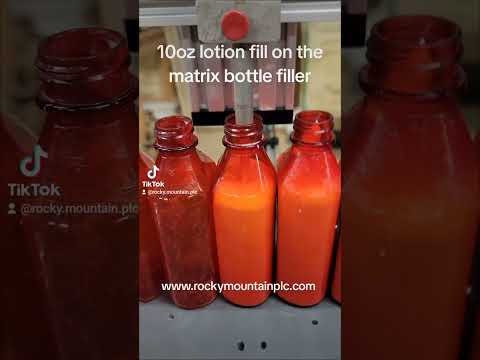
Around 2,000 bottles an hour with six nozzles, depending on product and bottle. Each extra pump head is $1,900 (HighLo heads are $2,500). You can see your own bottles per hour in the simulator.
Ready to price one? Build and price a Matrix filler, or ask us which pump fits.